
Eleven Campaigns Across Search’s Evolution
From classic keyword rankings to structured data, social recovery, and generative-search visibility — SEO work led by me, across industries and eras.
Index
- Earning a Place Inside AI Overviews, ChatGPT & Gemini — Leading Baby Care & Diaper Brand — Global
- Winning the Google for Jobs Search Unit — Kimberly-Clark — Global Career Portal
- Building an Enterprise SEO Operating System — Kimberly-Clark — Worldwide, Consumer Packaged Goods
- Jiva Ayurveda: Climbing 4.75 Positions on UTI Keywords in a Single Week
- Recovering from a Manual Link Action — Eureka Forbes — eurekaforbes.com
- Turning Structured Data into SERP Real Estate — Eureka Forbes — eurekaforbes.com
- Fixing Thin and Duplicate Content — Dabur Odomos Protect — odomosprotect.com
- Building Non-Brand Traffic From the Ground Up — Swadesi Cloud Platform
- 6,000+ New Impressions in a Single Month — Swadesi Cloud Platform
- A 400% Jump in Click-Through Rate — Our New Earth — Aster Hospitals’ health and wellness platform
- A 742% Rise in Search Impressions — The ADMC — Academy of Digital Marketing Courses
Earning a Place Inside AI Overviews, ChatGPT & Gemini
Leading Baby Care & Diaper Brand — Global
The Challenge
Generative search changed what “ranking” means. Parenting consumers were shifting from typed keywords to conversational questions, and the brand’s existing content — built for traditional SEO — wasn’t structured in a way AI engines could extract clean answers from. The result was limited visibility inside Google AI Overviews, ChatGPT, and Gemini at exactly the moment those surfaces were becoming a primary discovery channel, with no established authority on the high-intent diaper and parenting questions consumers were actually asking.
The Approach
My SEO team built a structured Answer Engine Optimization (AEO) and Generative Engine Optimization (GEO) program aimed squarely at making content AI-discoverable and answer-ready:
- Intent Optimization — mapped real parenting questions and structured each page around one clear primary intent with a direct answer.
- AI-Ready Content Architecture — rebuilt pages around semantic headings, short paragraphs, bullets, and topic clusters that support AI comprehension.
- Generative Search Enablement — aligned content to AEO/GEO requirements to improve visibility specifically within Google AI Overviews, ChatGPT, and Gemini.
- Technical SEO Foundation — strengthened schema markup, FAQs, metadata, crawl hierarchy, and Core Web Vitals to support reliable AI indexing.
- Governance & Content Consistency — standardized terminology and answer formats across the site to keep AI-surfaced responses accurate and on-brand.
The Result
In the first phase of the program, the brand saw measurable gains in generative discovery: content began surfacing directly inside Google AI Overviews, ChatGPT, and Gemini for high-intent parenting queries, with improved presence in direct AI answers and a consistent month-on-month rise in AI mentions and citations. The more extractable content also improved the on-site experience — getting parents to precise answers faster lifted engagement and trust signals along the way.
Winning the Google for Jobs Search Unit
Kimberly-Clark — Global Career Portal
The Challenge
Kimberly-Clark’s roles were already visible online — just not on Kimberly-Clark’s own site. Third-party job aggregators were indexing and ranking for the company’s open positions ahead of the official career portal, intercepting job seekers before they ever reached KC’s own listings. The objective was narrow but high-value: earn a place in Google’s dedicated job search unit (Google for Jobs) and redirect that intercepted demand back to the career portal itself.
The Approach
Google for Jobs isn’t won through content or backlinks — it runs entirely on structured data. That made this a technical SEO problem: get every open role represented correctly, completely, and in real time, in a format Google’s job index could trust ahead of third-party aggregators.
- Implemented Job Posting structured data across every role on the career portal, covering the fields Google’s job index actually surfaces — title, location, employment type, and posting date.
- Connected the portal to the Google Indexing API so new roles were submitted the moment they went live, and closed roles were pulled the moment they came down — removing the lag that let aggregators stay fresher than the source.
The Result
With structured, real-time job data feeding Google directly from the source, Kimberly-Clark’s own career portal began winning placement in the Google for Jobs unit ahead of the aggregators that had been capturing that traffic. Daily visits to the portal doubled, job search clicks rose 60% and impressions 52% over the year, and job pages collectively ranked for more than 1,100 keywords in job search results.
Structured data has only grown more central since this campaign ran. The same Job Posting schema that wins a place in Google for Jobs is also what lets AI Overviews, Gemini, and other AI-driven search experiences understand and surface a listing accurately — rather than relying on a third party’s summary of it. Getting the structured data and indexing plumbing right at the source is now table stakes for showing up correctly everywhere search is heading, not just in classic Google results.
About the Engagement
This work sat inside a broader SEO program built for Kimberly-Clark globally, spanning consumer packaged goods brands across multiple markets:
| Geography | Worldwide |
| Industry | Consumer Packaged Goods (CPG) |
| Scope | SEO KPI framework, standardized process and strategic planning across product brands, and technical SEO — structured data, Core Web Vitals, and ongoing health monitoring via Search Console, Bing/Yandex Webmaster Tools, and standard SEO auditing tools. |
The broader program focused on turning SEO health into decisions the brand could act on — tracking SERP visibility across Google’s different search units, surfacing keyword opportunity through content-gap and on-page analysis, and using engagement data on key pages to steer marketing strategy.
Building an Enterprise SEO Operating System
Kimberly-Clark — Worldwide, Consumer Packaged Goods
| Geography | Worldwide |
| Industry | Consumer Packaged Goods (CPG) |
| Distribution | Online |
The Challenge
Running SEO well for one brand is one thing; running it consistently across a portfolio of product brands under one global company is another. Without a shared KPI framework or standardized process, SEO strategy risked becoming inconsistent from brand to brand — making it hard to compare performance, prioritize investment, or roll learnings from one product line into another.
The Approach
My team proposed a tailored SEO KPI framework for Kimberly-Clark and used it to standardize SEO process and strategic planning across the company’s various product brands:
- Monitored SEO health on an ongoing basis using SEMrush, Moz, Screaming Frog, Google Search Console, and Bing/Yandex Webmaster Tools.
- Turned that monitoring into data-driven insight on organic visibility and traffic improvement, not just a health-check dashboard.
- Applied technical SEO implementations — structured data, Core Web Vitals, and related fundamentals — for stronger search presence across every brand site.
The Result
The framework gave Kimberly-Clark a consistent way to read SEO performance across brands: improved SERP rankings and organic traffic overall, clearer visibility into opportunities across Google’s different search units, keyword opportunity surfaced through audits, content-gap analysis, and on-page grading, and page-level engagement data the marketing team could use to plan what to do next.
Jiva Ayurveda: Climbing 4.75 Positions on UTI Keywords in a Single Week
Jiva Ayurveda — Ayurvedic healthcare platform
Overview
Jiva Ayurveda is a healthcare platform offering Ayurvedic remedies for a wide range of health concerns. During monsoon season, my SEO team identified a strategic opportunity around the broader keyword ‘UTI’ (Urinary Tract Infection) and set out to optimize content across this keyword cluster and its sub-categories.
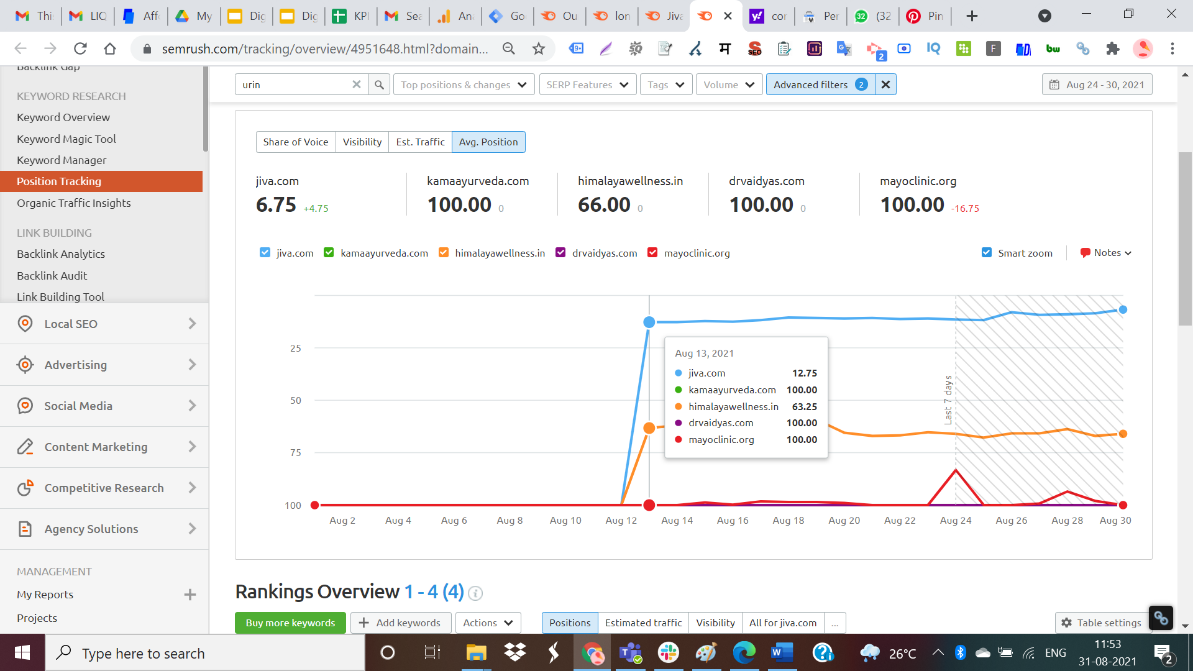
Within a week, Jiva Ayurveda’s average ranking position for UTI-specific keywords improved by 4.75 places — moving the brand back onto the first page of Google search results.
The Challenge
Monsoon is peak season for infections, and the team observed a sharp rise in YouTube searches related to Urinary Tract Infections. At the same time, Jiva Ayurveda had slipped to the second page of Google search results for its core UTI-specific keywords — a direct hit to visibility during a high-demand period.
The mandate was clear: bring Jiva Ayurveda back to page one for UTI-specific keywords and improve the average keyword position before the seasonal search spike passed.
Our Approach
Prior to this initiative, video optimization was handled reactively — covering only content that was already published or about to go live. There was no dedicated content plan for on-page or off-page blogs, and link-building activity was carried out on an ad hoc basis, without a clear focus area.
The combination of rising search demand, a falling average position, and unstructured link-building created urgency for a focused, topic-specific strategy built entirely around Urinary Tract Infection.
The Solution
The team consolidated its research into a single, focused strategy centered on the UTI keyword cluster:
- Thoughtfully optimized the core UTI landing page for search intent and relevance.
- Optimized 6 existing on-site blogs specific to Urinary Tract Infection.
- Published 2 off-site blogs to build topical authority and referral signals.
- Ran supporting link-building activity aligned to the UTI content cluster.
- Optimized YouTube video content and playlists for UTI-related search queries.
Results
The focused, cluster-based approach delivered a measurable jump in visibility within the same week the strategy was executed.
Average position of UTI-specific keywords: from 12.75 to 6.75 (+4.75) in one week.
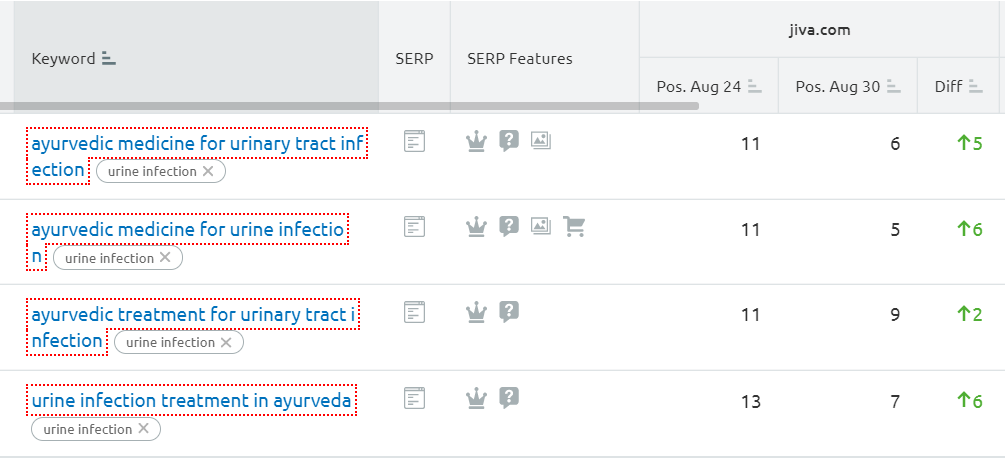
Keyword-level ranking movement across the UTI content cluster.
With the landing page, on-site blogs, off-site content, link building, and video assets all aligned around a single topic cluster, Jiva Ayurveda regained page-one visibility for its UTI-specific keywords — right as seasonal search demand was peaking.
Key Takeaway
Treating a seasonal spike as a signal — rather than reacting piecemeal across videos, blogs, and links — allowed the team to build one coherent content cluster around ‘UTI’. The result was a fast, measurable recovery in rankings and a stronger foundation for future seasonal search trends.
Recovering from a Manual Link Action
Eureka Forbes — eurekaforbes.com
The Challenge
Eureka Forbes was carrying a large, uneven backlink profile: leftover links from expired domains, low-quality directory submissions, and broken links pointing at pages that no longer existed after a site migration. Google’s link-spam systems flagged this as a partial manual action — warnings appeared in Search Console against specific product categories, primarily water purifiers and vacuum cleaners.
What We Did
- Ran a full backlink audit and sorted every referring domain into dangerous, suspicious, or neutral.
- Disavowed the dangerous links rather than chasing manual removal across thousands of unreachable webmasters.
- Cleaned up broken/legacy links left behind by the site migration.
- Filed a reconsideration request once the disavow file and cleanup were documented.
The Result
Search Console cleared the manual action, and rankings recovered sharply across the core product lines:
| Keyword | Rank Achieved |
|---|---|
| RO Water Purifier | #1 |
| Water Purifier | #2 |
| Vacuum Cleaner | #2 |
| Air Purifier | #2 |
| Water Purifiers | #5 |
Organic traffic, sales conversion, and overall search visibility all moved in step with the ranking recovery.
Link-spam detection is no longer a periodic sweep — it runs continuously inside Google’s core algorithm (the modern descendant of Penguin, now paired with systems like SpamBrain), and most low-quality links are simply devalued rather than triggering a penalty. Manual actions still happen, and the fix is unchanged in spirit: audit, disavow what’s genuinely harmful, and file reconsideration with clear documentation. What’s different is the posture — teams now spend less effort chasing every stray link and more on proactively earning links that wouldn’t need disavowing in the first place.
Turning Structured Data into SERP Real Estate
Eureka Forbes — eurekaforbes.com
The Challenge
Search engines could crawl Eureka Forbes’ pages but had no structured way to understand what was on them — which listings were products, which were reviews, which was a breadcrumb trail. That made the brand’s organic listings visually indistinguishable from any other blue link, at a time when rich snippets were starting to reshape click-through behavior on Google.
What We Did
- Implemented microdata/schema markup for breadcrumbs, products, offers, price, and ratings.
- Paired the markup with a cleaner, SEO-friendly site structure and navigation.
- Mapped brand-associated keywords (“Aquaguard,” “Euroclean,” “Forbes”) to the pages Google surfaced as sitelinks.
The Result
Branded searches began returning rich results with product ratings, pricing, and up to four sitelinks beneath the main listing — effectively giving Eureka Forbes the visual footprint of a paid ad within an organic result. Organic click-through outperformed the industry benchmark of the time (33%, per Search Engine Watch), with Eureka Forbes pulling 36% of its search traffic from organic listings.
Structured data hasn’t lost relevance — it’s become more important. JSON-LD has replaced inline microdata as the standard implementation, and schema now feeds more than blue-link rich snippets: it’s a key input for AI Overviews, Merchant listings, and how Google’s Knowledge Graph represents a brand. Sitelinks themselves remain fully algorithmic — no one can request them directly — but the underlying lever is unchanged: a clean site structure and well-marked-up content are still what earns them. The bigger shift is that ‘rich result’ now means earning a place inside an AI-generated summary, not just a prettier blue link.
Fixing Thin and Duplicate Content
Dabur Odomos Protect — odomosprotect.com
The Challenge
Odomos Protect was a small site — barely a dozen pages, most of them thin. Worse, several pages duplicated content already published on the parent Dabur site, creating a duplicate-content conflict. Under Google’s content-quality signals of the time (Panda), thin and duplicated pages struggled to rank even for a recognizable, trusted brand.
What We Did
- Split a single, overloaded ‘Diseases’ page into five dedicated pages — dengue, malaria, chikungunya, and others — each targeting its own keyword.
- Added a new page under ‘Zero Mosquito Tips’ to target ‘mosquito eradication’ directly.
- Rewrote overlapping copy so the site no longer duplicated Dabur’s own product pages.
- Supported the expanded content with external promotion — blogs, press releases, and video.
The Result
With more original, topic-specific pages for Google to index and rank, Odomos Protect moved into the top positions for its priority mosquito-protection terms:
| Keyword | Rank (Dec 2013) |
|---|---|
| Mosquito Anytime Protection | #1 |
| Outdoor Mosquito Protection | #2 |
| Kids Mosquito Protection | #2 |
| Avoid Mosquitoes Naturally | #2 |
| Mosquito Repellent | #8 |
The content-quality principle behind this fix — depth over duplication — hasn’t changed; Panda’s signals were folded into Google’s Helpful Content system and now sit inside the core ranking algorithm. What has changed is the promotion side. Several of the original distribution channels — mass web 2.0 posting, article directories, generic wiki links — read as manipulative today and are exactly the pattern Case Study 5’s link cleanup exists to undo. The modern equivalent is topic clusters built around genuine search intent, backed by digital PR and earned coverage rather than syndicated placements, with content structured so it can also be lifted cleanly into AI-generated answers.
Building Non-Brand Traffic From the Ground Up
Swadesi Cloud Platform — a homegrown digital asset management & cloud storage service
The Challenge
As a newly launched platform, Swadesi Cloud Platform had healthy traffic from users already searching for it by name — but almost no visibility for the generic, non-brand searches that would bring in people who didn’t yet know the product existed. Before the campaign, the site was publishing just one to two blog posts a week, nowhere near enough to compete for that space.
The Approach
My team treated closing that non-brand visibility gap as the primary goal, starting with a full review of which non-brand terms were already generating impressions — even without dedicated content behind them — to prioritize where a push would pay off fastest.
The Solution
- Scaled blog output to five posts a week, each mapped to a specific non-brand keyword.
- Ran on-page and off-page optimization as a daily, ongoing discipline rather than a one-off project.
- Built infographics and repurposed core content into multiple formats.
- Timed PR activity to coincide with major product launches.
The Result
Over three months, daily clicks rose 133.26% and daily impressions rose 163.41% — a durable shift in how much of the platform’s traffic came from people who found it through search rather than direct brand recall.
6,000+ New Impressions in a Single Month
Swadesi Cloud Platform — a homegrown digital asset management & cloud storage service
The Challenge
Brand-name searches dominated Swadesi Cloud Platform’s traffic, leaving the product with limited visibility among people searching generically for cloud storage — a gap that capped how many new users could discover it, and one that had to be closed without paid spend.
The Approach
My team leaned into the platform’s positioning as a homegrown, ‘desi’ alternative solving a global need, and used that angle to dig into the actual search queries people were typing when looking for reliable cloud storage — turning that data into a focused content plan.
The Solution
- Built content around high-volume, non-branded terms like ‘Indian cloud storage,’ ‘file transfer app,’ and ‘file storage app.’
- Repurposed that content across partner publishing platforms such as Medium, Substack, and HubPages to earn quality backlinks.
The Result
By May 2021, Swadesi Cloud Platform was ranking for non-branded keywords it hadn’t ranked for a month earlier — adding roughly 400 clicks and more than 6,000 impressions on Google Search compared to April.
A 400% Jump in Click-Through Rate
Our New Earth — Aster Hospitals’ health and wellness platform
The Challenge
Our New Earth, a health and wellness content platform run by Aster Hospitals, was publishing regularly but only driving traffic for a narrow set of keywords — things like ‘eye exercises for kids’ and ‘long distance marriage relationships.’ Despite the content output, click-through rate stayed flat.
The Approach
The existing off-page strategy leaned on discussion forums like Quora and Reddit, plus article submission and content curation sites. A review of keyword-tracking data showed the pattern behind the plateau: most of that off-page content was landing on low-Domain-Authority sites, and some of it wasn’t even topically related to the content it linked to.
The Solution
- Prioritized on-page optimization across existing content.
- Shortlisted high-search-volume, non-brand keywords aligned to real reader intent.
- Directed fresh content specifically at that keyword set.
- Repurposed content across submission sites, but shifted guest blogging to higher-DA websites.
- Added directory submissions, social bookmarking, and blog commenting as supporting signals.
The Result
Impressions rose by roughly 600 in the following month, driving CTR from 1% to 5.1% — a 400% improvement. The average position of the targeted non-brand keywords climbed from 38.5 to 24.6.
A 742% Rise in Search Impressions
The ADMC — Academy of Digital Marketing Courses
The Challenge
Competing in the digital marketing training space meant going up against far larger, better-known players. The ADMC was ranking for only a small set of low-search-volume keywords, and had little to no social promotion behind the content it did publish — a combination that kept it invisible for the searches that mattered most.
The Approach
My team built out a list of high-search-volume keywords specific to the digital marketing training space, giving the content calendar a clear target instead of publishing generically.
The Solution
- Committed to publishing four fresh content pieces every week, each mapped to a priority keyword.
- Promoted every piece consistently across the brand’s social channels.
The Result
In five months, site search impressions — combining brand and non-brand keywords — grew by 742%.
Source: internal campaign records, Google Search Console data, and third-party benchmarking tools.