
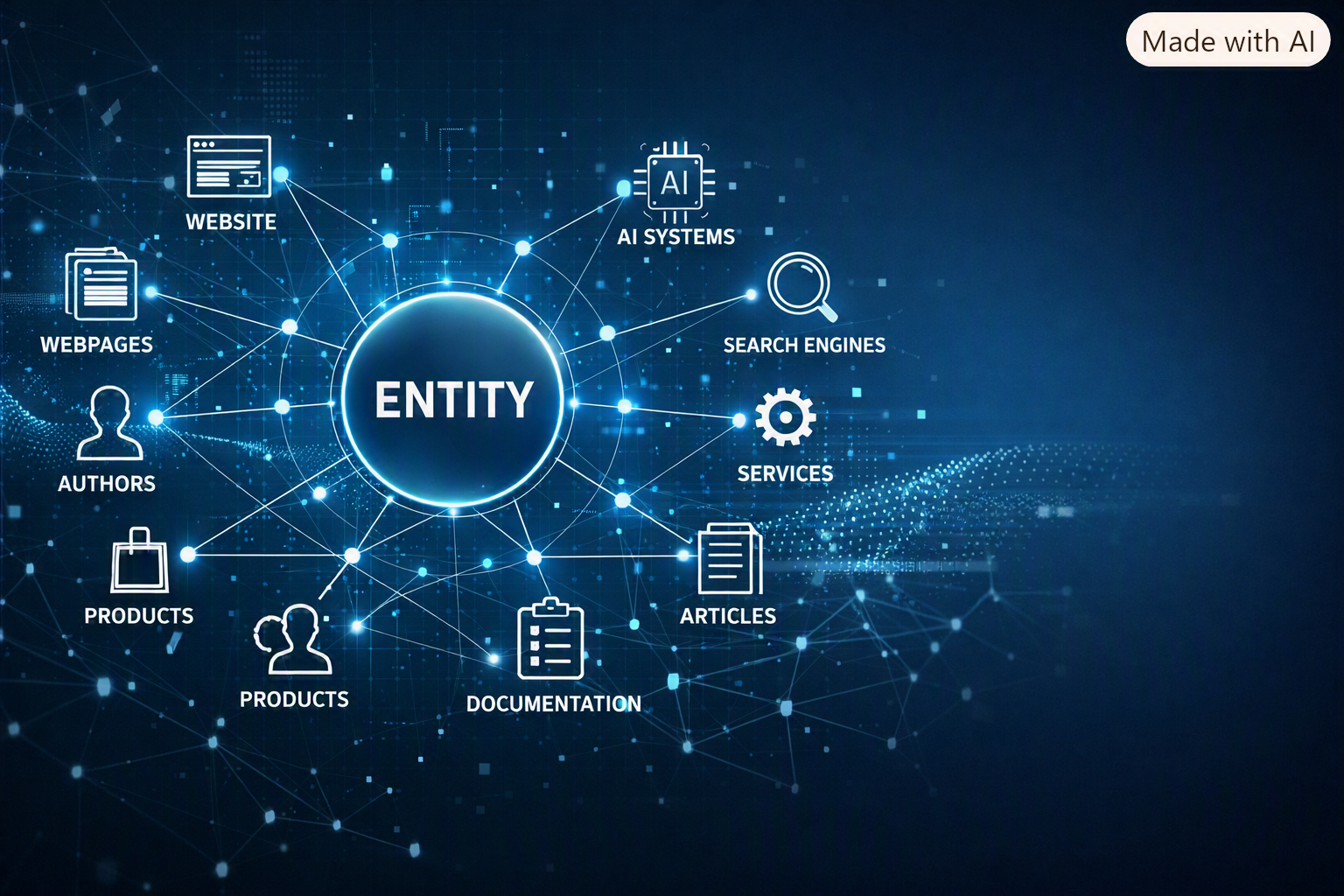
Search is evolving from keyword matching to entity understanding.
Traditional SEO has largely focused on optimizing individual pages for relevant keywords and improving their ability to rank in search results. Keywords remain important, but modern search systems increasingly evaluate the entities behind those keywords, along with their relationships, context, expertise, and supporting evidence.
AI-powered search experiences, including Google Search, AI Overviews, Bing Copilot, and large language models (LLMs), are designed to understand more than individual webpages.
They attempt to identify:
- Who is behind the website?
- What does the organization do?
- Which products and services does it offer?
- Who created or reviewed the content?
- How are people, topics, products, and services connected?
- Which sources demonstrate relevant expertise?
- Which pages represent the primary source of information?
This shift makes entity optimization one of the most important disciplines in modern SEO.
At the center of an effective entity strategy is a well-designed Schema.org graph architecture. A connected schema graph helps search engines and AI systems understand who you are, what you do, and how information across your website fits together.
What Is Entity Optimization?
Entity optimization is the process of helping search engines and AI systems recognize and understand a brand, person, product, service, location, or concept as a distinct and identifiable entity.
An entity is more than a keyword.
Consider these examples:
| Keyword or Search Topic | Recognizable Entity |
|---|---|
| Cloud migration | Microsoft Azure |
| SEO tools | Semrush |
| CRM software | Microsoft Dynamics 365 |
| AI assistant | Microsoft Copilot |
| E-commerce platform | Shopify |
A keyword is a word or phrase used to represent a search query or topic. An entity is a specific thing with an identity, attributes, relationships, and contextual meaning.
AI systems may use entities and their relationships to:
- Build and expand knowledge graphs
- Understand topical context
- Generate more relevant answers
- Connect expertise with content
- Identify brands, products, and people
- Evaluate source relevance
- Support attribution and citations
- Understand topical authority
For example, when a user asks:
“Which companies provide enterprise cloud migration services?”
An AI system is not simply looking for pages containing the phrase enterprise cloud migration services.
It may also evaluate:
- Which organizations are associated with cloud migration?
- Which cloud platforms do they specialize in?
- Do they provide relevant services?
- Are their experts connected to the organization?
- Do case studies demonstrate relevant experience?
- Are their claims supported by credible sources?
- Is the organization represented consistently across the web?
Entity optimization helps make these connections clearer.
Understanding an Entity Ecosystem
Consider a technology ecosystem such as Microsoft.
A person can easily understand the relationships between Microsoft, its products, services, experts, documentation, and customer stories:
Microsoft
│
├── Microsoft Azure
│     ├── Azure Kubernetes Service
│     ├── Azure AI
│     └── Azure Migration Services
│
├── Microsoft 365
│
├── Microsoft Copilot
│
├── Technical Experts
│
├── Documentation
│
└── Customer Success Stories
To a human, this ecosystem is naturally connected.
Microsoft is the parent organization. Azure is one of its technology platforms. Azure Kubernetes Service is part of the Azure ecosystem. Technical documentation explains how products work, while customer stories demonstrate real-world applications.
Search engines and AI systems need clear signals to understand these relationships consistently.
Entity optimization helps machines see the same connected picture that people see.
The Challenge: Many Websites Do Not Tell a Complete Entity Story
Many organizations unintentionally create disconnected digital experiences.
For example, a cloud consulting company may have:
- A cloud migration service page
- Azure consulting pages
- Expert author profiles
- Customer case studies
- Technical blog articles
- Product documentation
- Customer testimonials
- Partner information
To a website visitor, these assets may appear obviously related.
To a search engine or AI system, they may look like separate pieces of information unless the relationships are clearly established.
Without strong connections, AI systems may struggle to answer questions such as:
- Is this company an Azure partner?
- Does the organization provide cloud migration services?
- Do the listed experts work for the company?
- Does a case study demonstrate cloud migration experience?
- Is the technical article connected to the company’s service offering?
- Is the author qualified to discuss the topic?
- Which page is the primary source of information?
When these relationships are unclear, the website may have entity ambiguity.
Entity ambiguity can reduce machine confidence and make it more difficult for search engines and AI systems to connect an organization with its expertise, services, and content.
Why Entity Optimization Matters for AI Search
Generative search experiences depend heavily on understanding entities and relationships.
AI systems attempt to answer questions by identifying relevant concepts, evaluating source information, connecting related entities, and generating a useful response.
This requires them to understand:
- Who owns the website?
- What products or services does the organization provide?
- Which topics is the organization associated with?
- How are products related to one another?
- Which experts created or reviewed the content?
- Which pages represent primary information?
- What evidence supports the organization’s expertise?
Without strong entity signals, AI systems may:
- Misattribute content
- Miss important relationships
- Fail to connect experts with the organization
- Misunderstand products or services
- Overlook relevant evidence
- Generate incomplete answers
- Underestimate topical authority
A structured entity framework improves machine interpretability by making important relationships explicit.
The Limitations of Traditional Schema Implementations
Many websites have added structured data gradually over several years.
A typical implementation may include separate schema blocks for:
- Organization
- WebSite
- WebPage
- BreadcrumbList
- Article
- Product
- FAQPage
Adding these schema types is useful, but problems can arise when each implementation functions as an isolated data block.
Fragmented Structured Data
Each schema object may exist independently without a clear connection to the others.
For example, the Organization entity may not be connected to the WebSite entity, and the Article entity may not identify its relationship with the organization or author.
Missing Entity Relationships
A website may define its organization, pages, articles, products, and authors without explaining how they relate.
The information exists, but the entity graph is incomplete.
Inconsistent Entity IDs
Different templates or plugins may generate different identifiers for the same organization, website, or person.
This can create duplication and weaken entity consistency.
Maintenance Challenges
Schema updates may require changes across multiple templates, plugins, components, or CMS fields.
As a website grows, maintaining consistency becomes more difficult.
Scalability Issues
Managing hundreds or thousands of disconnected schema implementations can become inefficient and error-prone.
For AI systems, fragmented structured data may limit the clarity of entity relationships.
Moving to a Unified Schema Graph Architecture
A more scalable approach is to implement a centralized JSON-LD @graph architecture.
Instead of publishing separate and disconnected schema blocks, related entities are included in a connected graph.
A simplified structure may look like this:
Organization
    │
    ├── WebSite
    │     │
    │     └── WebPage
    │            │
    │            ├── Article
    │            ├── Product
    │            ├── Service
    │            └── FAQPage
    │
    └── Person
          │
          └── Author
This architecture creates a machine-readable representation of how the website is organized.
The goal is not simply to add more schema. The goal is to establish meaningful relationships between entities.
For example:
- The Organization owns or publishes the website.
- The WebSite contains webpages.
- A WebPage contains the primary content entity.
- An Article is published by the organization.
- A Person is connected to the article as its author.
- A Service is connected to relevant case studies.
- A Product is connected to documentation and supporting resources.
The graph becomes a structured representation of the organization’s digital ecosystem.
Core Components of an AI-Ready Entity Graph
1. Organization Entity
The Organization should act as a primary entity in the website’s schema graph.
{
  "@id": "https://example.com/#organization",
  "@type": "Organization",
  "name": "Example Inc.",
  "url": "https://example.com/",
  "logo": {
    "@id": "https://example.com/#logo"
  }
}
The Organization entity can act as a central reference point for:
- Brand identity
- Website ownership
- Publishing relationships
- Products and services
- Employees and experts
- Social profiles
- Contact information
A stable @id helps ensure that the same organization is referenced consistently throughout the website.
2. WebSite Entity
The WebSite entity should connect directly to the Organization.
{
  "@id": "https://example.com/#website",
  "@type": "WebSite",
  "url": "https://example.com/",
  "name": "Example Inc.",
  "publisher": {
    "@id": "https://example.com/#organization"
  }
}
This relationship helps establish that the organization is responsible for publishing the website.
The same Organization @id should be reused across relevant pages rather than creating a new organization entity for every page.
3. WebPage Entity
Each important webpage can be represented as an entity within the graph.
{
  "@id": "https://example.com/services/cloud-migration/#webpage",
  "@type": "WebPage",
  "url": "https://example.com/services/cloud-migration/",
  "isPartOf": {
    "@id": "https://example.com/#website"
  }
}
This establishes the page’s relationship with the overall website.
Depending on the page type, additional properties may describe:
- The primary entity discussed on the page
- The page’s relationship with a parent section
- Breadcrumb hierarchy
- Publishing or modification dates
- The main content entity
4. Content Entities
The primary content on a page should connect directly to the WebPage entity.
Example Article:
{
  "@id": "https://example.com/blog/entity-optimization/#article",
  "@type": "Article",
  "mainEntityOfPage": {
    "@id": "https://example.com/blog/entity-optimization/#webpage"
  },
  "publisher": {
    "@id": "https://example.com/#organization"
  }
}
This relationship makes it clear that:
- The article is the primary content entity.
- The article belongs to a specific webpage.
- The organization is the publisher.
The same model can be adapted for:
- Products
- Services
- Documentation
- Case studies
- Events
- Videos
- FAQs
5. Person and Author Entities
Author entities help clarify who created, contributed to, or reviewed content.
{
  "@id": "https://example.com/authors/john-doe/#person",
  "@type": "Person",
  "name": "John Doe",
  "url": "https://example.com/authors/john-doe/"
}
The Article can then reference the author:
{
  "@type": "Article",
  "author": {
    "@id": "https://example.com/authors/john-doe/#person"
  }
}
This creates a clear authorship relationship between the organization, author, and content.
Author pages can also provide:
- Professional role
- Areas of expertise
- Professional biography
- Credentials
- Publications
- Organization affiliation
- Relevant professional profiles
These signals should accurately represent the real-world relationship between the person, organization, and content.
Example of a Unified @graph Implementation
{
  "@context": "https://schema.org",
  "@graph": [
    {
      "@id": "https://example.com/#organization",
      "@type": "Organization",
      "name": "Example Inc.",
      "url": "https://example.com/"
    },
    {
      "@id": "https://example.com/#website",
      "@type": "WebSite",
      "url": "https://example.com/",
      "publisher": {
        "@id": "https://example.com/#organization"
      }
    },
    {
      "@id": "https://example.com/blog/entity-optimization/#webpage",
      "@type": "WebPage",
      "url": "https://example.com/blog/entity-optimization/",
      "isPartOf": {
        "@id": "https://example.com/#website"
      }
    },
    {
      "@id": "https://example.com/blog/entity-optimization/#article",
      "@type": "Article",
      "mainEntityOfPage": {
        "@id": "https://example.com/blog/entity-optimization/#webpage"
      },
      "publisher": {
        "@id": "https://example.com/#organization"
      }
    }
  ]
}
This graph explicitly communicates relationships rather than requiring search engines or AI systems to infer them.
The key benefit is not the use of @graph alone. The value comes from creating stable, accurate, and meaningful connections between entities.
Entity Hub Strategy for AI Visibility
Schema is important, but schema alone is not enough.
A strong entity optimization strategy should also create meaningful content and navigation structures around important entities.
Dedicated entity hubs can strengthen topical context and make relationships easier for both users and machines to understand.
Product Entity Hubs
A product hub may include:
- Product overview
- Features and capabilities
- Use cases
- Technical specifications
- Pricing information
- Documentation
- FAQs
- Customer success stories
- Related products
Service Entity Hubs
A service hub may include:
- Service overview
- Business challenges addressed
- Delivery approach
- Industry applications
- Case studies
- Customer success stories
- Expert insights
- Related resources
People and Expert Hubs
An expert hub may include:
- Author profile
- Professional biography
- Areas of expertise
- Credentials
- Publications
- Articles written or reviewed
- Professional profiles
- Organization affiliation
Topic Entity Hubs
A topic hub may include:
- Pillar content
- Supporting articles
- Research papers
- Guides
- FAQs
- Videos
- Thought-leadership content
- Related products or services
Each hub helps reinforce the entity’s identity and relationship with the wider website ecosystem.
Beyond Schema: Reinforcing Entity Signals
The strongest entity optimization programs combine structured data with clear on-page information, internal linking, consistent naming, comprehensive topical coverage, and external validation.
Internal Linking
Internal links help establish relationships between entities.
Examples include:
- Service → Relevant case study
- Author → Articles written by the author
- Product → Technical documentation
- Product → Related solutions
- Expert → Areas of expertise
- Topic hub → Supporting articles
- Case study → Relevant service
The anchor text and surrounding context should clearly communicate the relationship.
Consistent Entity Naming
Use standardized names across:
- Page titles
- Headings
- Body content
- Schema markup
- Author profiles
- Navigation
- Social profiles
- External business listings
Avoid unnecessary variations that may create ambiguity.
External Entity Validation
External sources can reinforce entity recognition and provide independent evidence.
Relevant sources may include:
- Wikidata
- Official professional profiles
- Industry directories
- Partner websites
- Reputable news publications
- Conference websites
- Professional associations
- Authoritative business databases
External references should be accurate and consistent with the organization’s official information.
Comprehensive Topical Coverage
Avoid creating isolated pages targeting individual keywords without explaining how they relate to the broader topic.
Instead, build meaningful coverage around the complete entity ecosystem.
For example, a cloud migration topic may include:
- Cloud migration strategy
- Cloud readiness assessment
- Migration planning
- Azure migration services
- Application modernization
- Cloud security
- Migration case studies
- Technical documentation
- Expert guidance
This creates a stronger topical framework than publishing disconnected keyword-focused articles.
Measuring Entity Optimization Success
Entity optimization should be measured using more than traditional keyword rankings.
Monitor:
- Structured data validation and error coverage
- Rich result eligibility and visibility
- Branded search growth
- Growth in relevant non-branded queries
- AI Overview visibility
- Presence in AI-generated answers
- Knowledge panel visibility, where applicable
- Entity recognition consistency
- Citation frequency in AI search experiences
- Share of voice across AI platforms
- Growth in entity-related impressions
- Organic traffic to entity hubs
- Internal-link engagement between related entities
- Coverage of important entity relationships
As AI search experiences continue to evolve, measurement should focus on visibility, attribution, consistency, and business outcomes—not only on keyword rankings.
Entity Optimization Checklist
Use this checklist when designing an AI-ready entity architecture:
- Define the organization as a primary entity.
- Use a stable Organization
@id. - Connect the WebSite to the Organization.
- Connect each WebPage to the WebSite.
- Define the primary content entity for important pages.
- Connect Articles to their authors.
- Connect authors to accurate profile pages.
- Connect products and services to relevant supporting content.
- Use consistent entity names across the website.
- Build dedicated entity hubs.
- Strengthen relationships through contextual internal links.
- Maintain accurate and consistent external profiles.
- Validate structured data regularly.
- Monitor entity visibility across traditional and AI-powered search experiences.
- Review the entity graph whenever the website architecture changes.
Frequently Asked Questions
What is entity optimization in SEO?
Entity optimization is the process of helping search engines and AI systems understand a brand, person, product, service, location, or topic as a distinct entity with identifiable attributes and relationships. It combines structured data, content, internal linking, consistent naming, and external validation.
What is a Schema.org @graph?
A Schema.org @graph is a JSON-LD structure that contains multiple connected schema entities in one graph. It can define relationships between an organization, website, webpage, article, author, product, service, and other entities.
Why is entity optimization important for AI search?
AI search systems need to understand who created content, what an organization does, how topics are connected, and which sources demonstrate relevant expertise. Strong entity signals can improve machine interpretability and help AI systems understand content in the correct context.
Is schema markup enough for entity optimization?
No. Schema markup is an important part of entity optimization, but it should be supported by accurate on-page content, clear internal linking, consistent entity naming, expert profiles, topical coverage, and credible external references.
What is the difference between a keyword and an entity?
A keyword is a word or phrase associated with a search query or topic. An entity is a specific and identifiable person, organization, product, service, location, or concept with attributes and relationships.
How does a schema graph support AI SEO?
A schema graph makes relationships between entities explicit. For example, it can show that an organization publishes a website, an author works with the organization, and an article belongs to a specific webpage. These connections improve machine-readable context.
Should every webpage have its own schema entity?
Important webpages should generally have an appropriate WebPage entity, along with relevant content schema such as Article, Product, Service, or another suitable type. The implementation should reflect the actual content and purpose of the page.
What should be included in an entity hub?
An entity hub may include an overview page, supporting content, documentation, FAQs, case studies, expert information, related products or services, and contextual internal links.
Final Thoughts
The future of SEO is increasingly becoming the future of entity management.
As AI-powered search systems rely more heavily on relationships, context, source understanding, and knowledge graphs, websites need to move beyond isolated pages and disconnected schema implementations.
A unified @graph-based Schema.org architecture provides a strong technical foundation by connecting:
- Organizations
- Websites
- Webpages
- Authors
- Articles
- Products
- Services
- Case studies
- Documentation
- Topics
However, structured data is only one part of the strategy.
Strong entity optimization also requires consistent naming, meaningful internal linking, comprehensive topical coverage, credible expert information, and accurate external validation.
The goal is to create a clear and connected digital representation of the organization—one that helps people, search engines, and AI systems understand who you are, what you do, and why your content is relevant.
Organizations that invest in entity-first SEO today may be better positioned to earn visibility not only in traditional search results but also in AI-generated experiences where understanding entities can influence which sources become trusted answers.